NEW YORK -- It could have been a college reunion: hugs, tears, laughter, photos, and a big friendly guy in shorts and sneakers organizing it all. But the guy in shorts was Michael Moore, whose new documentary, "Sicko," takes aim at the U.S. health care industry with the same fury - laced with humor, of course, and plenty of statistics - that he directed at the Bush administration in his hit "Fahrenheit 9/11."
And the people who'd flown in for this intimate first screening, a day after the film had been shipped to the Cannes Film Festival, included grateful Sept. 11 "first responders," suffering lung problems or other ailments from their days at ground zero. In the film, Moore takes them to Cuba and tries to get them treated at the U.S. base at Guantanamo Bay - where, he contends, terror suspects were getting better medical care than the heroes of 9/11.
...
At his screening Tuesday evening at a Manhattan hotel, however, Moore was focused on the reaction of his invited guests.
"Three years ago tonight, we had the first screening of 'Fahrenheit 9/11,' with victims' families," he told them. "It was a very powerful experience, and now we're honored to have all of you here. We're very proud of this film. We're confident it will have a significant impact."
When the lights came up, Reggie Cervantes, a former 9/11 "first responder" who now lives in Oklahoma, spoke first.
"It was funny. It was real," said Cervantes, 46, who says she suffers from pulmonary ailments, esophageal reflex, post-traumatic stress disorder, ear and eye infections and other problems stemming from time at ground zero. Of the trip, she said: "It feels surreal. Were we really there?"
...
The patients he brought had all struggled at home with health care costs. Some, like Cervantes, had lost their health insurance because they could no longer work, and were navigating the workmen's compensation system.
John Graham, a disabled carpenter and EMT from Paramus, N.J., came to the screening with his daughters. On 9/11 he was at his job at the carpenter's union offices, near the World Trade Center. He rushed over before the second plane hit, spending 31 hours at first, then helping out for months after that. He says he was later diagnosed with lung problems, burns on his esophagus, chronic sinusitis and post-traumatic stress disorder, among other things: "I need a notebook to remember everything."
Graham, who stopped working in 2004, now lives on $400 per week in workmen's comp payments. He split from his wife and says he is unable to keep up with childcare payments.
In Cuba, Graham had five full days of medical tests and received medication for his reflux problems. Cervantes was treated for eye and nose infections, among other things, and in a drugstore found pills for only pennies that cost her more than $100 at home. Maher had the longest treatment, to correct dental problems - he said ground zero-related stress and dreams about "people falling from the sky" made him grind his teeth at night.
Moore hopes his latest film will make people stop and think about what he sees as the tragic ills of the health care industry.
"We are the richest country in the world," the director said. "We spend more on health care than any other country. Yet we have the worst health care in the Western world. Come on. We can do better than this."
Saturday, May 19, 2007
Oklahoma Resident First Responder of 9/11 Praises Sicko Movie
From the AP:


Thursday, May 17, 2007
135 MPG Starting At Only $92,000!
Tesla Motors has a new electric car that goes over 200 miles per charge, according to its website. But at $92,000, you would have to keep the car for quite a while to make up the difference in a Honda Civic or Toyota Corolla.
But if you want a fast car (zero to sixty in "about" 4 seconds), and you want to make some sort of environmental statement (besides the damage done by all the extra batteries), and you have an extra $100,000 to burn, then this car might be for you.
But if you want a fast car (zero to sixty in "about" 4 seconds), and you want to make some sort of environmental statement (besides the damage done by all the extra batteries), and you have an extra $100,000 to burn, then this car might be for you.
Wednesday, May 16, 2007
Is Saudi Arabia Running Out of Oil?
In a report over at The Oil Drum, blogger Stuart Staniford argues that the Ghawar oil fields are starting to get depleted and that this accounts for the recent rise in oil prices. The post comes with a lot of maps, charts and technical analysis. I am reproducing some of them here with some of his analysis.

Visualization of oil saturation in Ghawar, with focus region on 'Ain Dar and Shedgum regions at northern end. This is the "Linux Supercluster" picture (finder's credit Bob Shaw), showing a simulation visualization of the state of Ghawar at some year, probably but not certainly 2004. I have color reversed the original picture so that in this version, the red areas are interpreted to represent dry oil in the reservoir. The dark blue areas are water below the oil. The pale blue areas are interpreted to be swept, with most oil that can be removed already gone. Source: Figure 3 of Linux Clusters Driving Step Changes in Interpretation Simulation (pdf).
Mr. Staniford then asks:

Saudi Arabian oil production, Jan 2002-Jan 2007, average of four different sources. Annotations show important events causally influencing production, including all documented megaprojects for new supply in the the time period. Graph is not zero-scaled to better show changes. Click to enlarge. Source: US EIA International Petroleum Monthly Table 1.1, IEA Oil Market Report Table 3, Joint Oil Data Initiative, OPEC Monthly Oil Market Report, Table 17 (or similar) on OPEC Supply.
I don't know if this is disinformation just meant to create panic (and therefore drive up the price of oil), or if the shortage due to this one region is just temporary. I can just tell you that the general feeling is that cheap oil is starting to run out. In any case, I think that the link at the top is worth a look.
Before I go on, I think I should give a disclaimer (which I am borrowing, for the most part, from Mike Shedlock's site):
The content on this site is provided as general information only and should not be taken as investment advice. All site content, including advertisements, shall not be construed as a recommendation to buy or sell any security or financial instrument, or to participate in any particular trading or investment strategy (or an endorsement or recommendation of any product on any ad). The ideas expressed on this site are solely the opinions of the author(s) who may or may not have a position in any company or advertiser referenced above. Any action that you take as a result of information, analysis, or advertisement on this site is ultimately your responsibility. Consult your investment adviser before making any investment decisions.
If Saudi Arabia is truly starting to run out of oil, then we here in America need to get cracking developing technology to make our use of oil more efficient and develop alternative forms of energy. Most of our electricity comes from burning coal; and while we have a 250-year supply of it, it burns very dirty. Different areas of the country are more suitable to other, cleaner, forms of energy production: solar, wind and hydro power. Each of these are renewable and relatively clean forms of energy production. While current technology does not allow for these forms of energy production to be used widely, it would be wise for Americans to put our smartest minds to work creating more energy-efficient automobiles and buildings. Rather than looking toward converting food crops into more oil for our cars, we need to focus on making our cities more fuel efficient and develop more mass transit lines so that we can cut unnecessary oil usage.
It is my feeling that we, here in America, need to use our strength of innovation to solve our energy problems rather than looking for ways to produce more energy. Our real problem is that we are wasting too much energy that we have access to now. Reducing the demand on oil by conserving and increasing energy efficiency would be the smartest and most effective method of driving down our energy costs.

Visualization of oil saturation in Ghawar, with focus region on 'Ain Dar and Shedgum regions at northern end. This is the "Linux Supercluster" picture (finder's credit Bob Shaw), showing a simulation visualization of the state of Ghawar at some year, probably but not certainly 2004. I have color reversed the original picture so that in this version, the red areas are interpreted to represent dry oil in the reservoir. The dark blue areas are water below the oil. The pale blue areas are interpreted to be swept, with most oil that can be removed already gone. Source: Figure 3 of Linux Clusters Driving Step Changes in Interpretation Simulation (pdf).
Mr. Staniford then asks:
Here the question is: is this an accurate picture of the state of recent depletion of Ghawar? (Ghawar is the world's largest oil field, and source of over half of the oil produced by Saudi Arabia).
And if so, then the second question arises: does that depletion have anything to do with this picture?
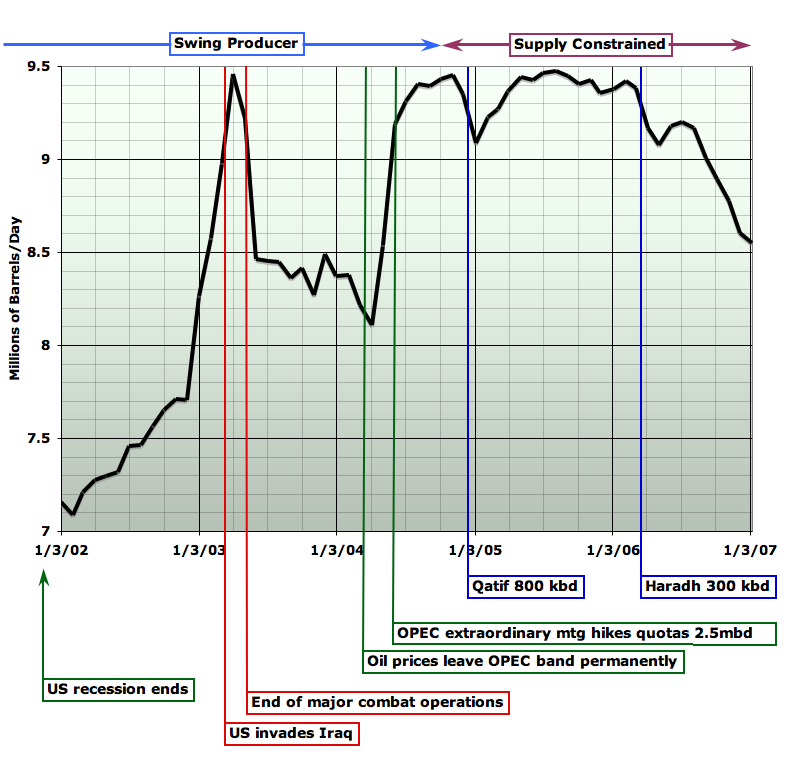
Saudi Arabian oil production, Jan 2002-Jan 2007, average of four different sources. Annotations show important events causally influencing production, including all documented megaprojects for new supply in the the time period. Graph is not zero-scaled to better show changes. Click to enlarge. Source: US EIA International Petroleum Monthly Table 1.1, IEA Oil Market Report Table 3, Joint Oil Data Initiative, OPEC Monthly Oil Market Report, Table 17 (or similar) on OPEC Supply.
In particular, Saudi oil production has been falling with increasing speeed since summer 2005, and overall, since mid 2004, about 2 million barrels of oil per day in production has gone missing (about 1mbpd in reduction in total production, and about another 1mbpd in that two major new projects, Qatif and Haradh III, failed to increase overall production). That's 2.5% of world production and, if that production hadn't gone missing, gasoline in the US likely would still be somewhere in the vicinity of $2/gallon instead of well over $3.
I will analyze six or seven separate lines of technical evidence, and argue they all point to a consistent picture, which says that the answer to both questions is "Yes". Yes, the northern half of Ghawar is quite depleted. And yes, this probably explains at least part of recent production declines. Furthermore, it is likely that more declines in Saudi production are on the way.
I don't know if this is disinformation just meant to create panic (and therefore drive up the price of oil), or if the shortage due to this one region is just temporary. I can just tell you that the general feeling is that cheap oil is starting to run out. In any case, I think that the link at the top is worth a look.
Before I go on, I think I should give a disclaimer (which I am borrowing, for the most part, from Mike Shedlock's site):
The content on this site is provided as general information only and should not be taken as investment advice. All site content, including advertisements, shall not be construed as a recommendation to buy or sell any security or financial instrument, or to participate in any particular trading or investment strategy (or an endorsement or recommendation of any product on any ad). The ideas expressed on this site are solely the opinions of the author(s) who may or may not have a position in any company or advertiser referenced above. Any action that you take as a result of information, analysis, or advertisement on this site is ultimately your responsibility. Consult your investment adviser before making any investment decisions.
If Saudi Arabia is truly starting to run out of oil, then we here in America need to get cracking developing technology to make our use of oil more efficient and develop alternative forms of energy. Most of our electricity comes from burning coal; and while we have a 250-year supply of it, it burns very dirty. Different areas of the country are more suitable to other, cleaner, forms of energy production: solar, wind and hydro power. Each of these are renewable and relatively clean forms of energy production. While current technology does not allow for these forms of energy production to be used widely, it would be wise for Americans to put our smartest minds to work creating more energy-efficient automobiles and buildings. Rather than looking toward converting food crops into more oil for our cars, we need to focus on making our cities more fuel efficient and develop more mass transit lines so that we can cut unnecessary oil usage.
It is my feeling that we, here in America, need to use our strength of innovation to solve our energy problems rather than looking for ways to produce more energy. Our real problem is that we are wasting too much energy that we have access to now. Reducing the demand on oil by conserving and increasing energy efficiency would be the smartest and most effective method of driving down our energy costs.
Monday, May 14, 2007
The Ubiquitousness of Poverty
Today I read a book review by Nicholas Kristof of Poor People by William Vollmann. I found these paragraphs disquieting:
I have been thinking about all of the wars that take place in the world today. I have often wondered how many of those wars are fought over such simple things as access to clean, potable water? Many wars, historically, are fought over access to natural resources.
It makes me wonder: how much money it would cost to provide clean, potable water to everyone in the world? How many needless deaths can we prevent just by expanding access to water? Water is life. Where you find water, you find civilization. Many of the diseases that Bill Gates and Warren Buffett want to eradicate probably start from unclean water supplies. I don't think it is enough to go after the diseases themselves. We need to go after their root causes.
How does this tie in to my post? Most of these people cannot afford individually -- even collectively -- to build water treatment plants. They cannot build wells deep enough to reach potable water and bring it to the surface. Some countries might be able to utilize water from the sea if they could afford desalinization plants.
This is the sort of problem that truly does need cooperation from everyone in the world and funding primarily from wealthy countries and individuals.
One measure of the ubiquity of these tradeoffs is that today, as every day, 30,000 children will die of hunger, disease, and other consequences of poverty, according to UNICEF. In many cases, those will be daughters, because parents (particularly in South Asia) don't have the resources to keep all their children alive, so they put a finger on the scales on the side of their sons. In India alone, among children aged one to five, girls are 50 percent more likely to die than boys—meaning that 130,000 Indian girls are mortally discriminated against each year.
Poverty both in the US and around the world remains a central fact of twenty-first-century life; a majority of the world lives on less than $2 a day, one common measure of who is poor. Yet we manage, pretty successfully, to ignore it and insulate ourselves even from poverty in our own country. When it pops out from behind the screen after an episode like the Watts riots of 1965 or the New Orleans hurricane of 2005, then we express horror and indignation and vow change, and finally shrug and move on. Meanwhile, the world's five hundred wealthiest people have the same income as the world's poorest 416 million.
I have been thinking about all of the wars that take place in the world today. I have often wondered how many of those wars are fought over such simple things as access to clean, potable water? Many wars, historically, are fought over access to natural resources.
It makes me wonder: how much money it would cost to provide clean, potable water to everyone in the world? How many needless deaths can we prevent just by expanding access to water? Water is life. Where you find water, you find civilization. Many of the diseases that Bill Gates and Warren Buffett want to eradicate probably start from unclean water supplies. I don't think it is enough to go after the diseases themselves. We need to go after their root causes.
How does this tie in to my post? Most of these people cannot afford individually -- even collectively -- to build water treatment plants. They cannot build wells deep enough to reach potable water and bring it to the surface. Some countries might be able to utilize water from the sea if they could afford desalinization plants.
This is the sort of problem that truly does need cooperation from everyone in the world and funding primarily from wealthy countries and individuals.
Building Wealth
I saw this at at Bankrate.com:
I thought: "This would be a great lesson on why we need a national pension system." But, no; that is not the point the writer, Jennifer Openshaw, could think to make. Instead, she said "buy real estate" because
This is a common theme in financial "self-help" books; but really now, how many people can afford a second home on $30,000 per year? How many people can afford their first home on $30,000 per year? What if the home loses value? (You can read about that problem over at The Housing Bubble Blog and Calculated Risk Blog.) These "financial gurus" never seem to talk about that.
She also talks about the need to have adequate health care insurance.
What is it about these financial gurus and the disconnect between the examples they give of the financial situations of the people they use as examples and the solutions they give? They always seem to give millionaire answers to people with immediate cash-flow hundredaire problems. The problem isn't just that Americans are using too many credit cards (although that is a component of the problem); the problem is also that the working class is not being compensated based on their productivity and sharing in the profits thereof.
The answer actually is pretty obvious: pressure businesses to raise their employees pay so they can save adequately and raise taxes on the wealthiest to pay for the social services and programs that the working class is going to need.
Take a 30-year-old earning $30,000. He or she would only have $216,000 in a 401(k) at age 67, assuming he or she was saving 3 percent of salary, the company was providing a 1.5 percent match and their investments were returning 7 percent per year, according to Vanguard.
So, the sad truth is that nine of 10 American baby boomers have less than $250,000 saved for retirement, a 2005 survey commissioned by Merrill Lynch found. As we've seen, that isn't enough. And if you're hoping for a pension, well, good luck, because half of working Americans don't have a pension plan and even if you do, you can't count on it being there later because corporate America has been shifting away from pension promises. As Americans, we've got to take personal responsibility for our financial future and that of our families.
I thought: "This would be a great lesson on why we need a national pension system." But, no; that is not the point the writer, Jennifer Openshaw, could think to make. Instead, she said "buy real estate" because
"it's tangible and, as an investor, you can enjoy both the appreciation and the income generated as rents rise in the future. Plus, you get the power of leverage with your money -- something you don't get with many other investments -- meaning you might put only 20 percent down but you enjoy appreciation on the entire value of the home."
This is a common theme in financial "self-help" books; but really now, how many people can afford a second home on $30,000 per year? How many people can afford their first home on $30,000 per year? What if the home loses value? (You can read about that problem over at The Housing Bubble Blog and Calculated Risk Blog.) These "financial gurus" never seem to talk about that.
She also talks about the need to have adequate health care insurance.
What is it about these financial gurus and the disconnect between the examples they give of the financial situations of the people they use as examples and the solutions they give? They always seem to give millionaire answers to people with immediate cash-flow hundredaire problems. The problem isn't just that Americans are using too many credit cards (although that is a component of the problem); the problem is also that the working class is not being compensated based on their productivity and sharing in the profits thereof.
The answer actually is pretty obvious: pressure businesses to raise their employees pay so they can save adequately and raise taxes on the wealthiest to pay for the social services and programs that the working class is going to need.
Sunday, May 13, 2007
Strong Hand of Love
The song Strong Hand of Love was Mark Heard's biggest "hit." I just found a MySpace page today that will play the entire song online.
If the song doesn't load up when the page first loads, you can just click on the Song title in the upper right hand corner.
Here are the lyrics from MarkHeard.net:
Strong Hand Of Love
Down peppers the rain from a clear blue sky
Down trickles a tear on a youthful face
Feeling in haste and wondering why
Up struggles the sun from a wounded night
Out venture our hearts from their silent shrouds
Trying to ignite but wondering how
We can laugh and we can cry
And never see the strong hand of love hidden in the shadows
We can dance and we can sigh
And never see the strong hand of love hidden in the shadows
Young dreamers explode like popped balloons
Some kind of emotional rodeo
Learning too slow and acting too soon
Time marches away like a lost platoon
We gracefully age as we feel the weight
Of loving too late and leaving too soon
We can laugh and we can cry
And never see the strong hand of love hidden in the shadows
We can dance and we can sigh
And never see the strong hand of love hidden in the shadows
Written by Mark Heard © 1990 Ideola Music
If the song doesn't load up when the page first loads, you can just click on the Song title in the upper right hand corner.
Here are the lyrics from MarkHeard.net:
Strong Hand Of Love
Down peppers the rain from a clear blue sky
Down trickles a tear on a youthful face
Feeling in haste and wondering why
Up struggles the sun from a wounded night
Out venture our hearts from their silent shrouds
Trying to ignite but wondering how
We can laugh and we can cry
And never see the strong hand of love hidden in the shadows
We can dance and we can sigh
And never see the strong hand of love hidden in the shadows
Young dreamers explode like popped balloons
Some kind of emotional rodeo
Learning too slow and acting too soon
Time marches away like a lost platoon
We gracefully age as we feel the weight
Of loving too late and leaving too soon
We can laugh and we can cry
And never see the strong hand of love hidden in the shadows
We can dance and we can sigh
And never see the strong hand of love hidden in the shadows
Written by Mark Heard © 1990 Ideola Music
Sunday Music: Chess
Starting Tuesday, the 2007 Frank Berry U.S. Chess Championship starts in Stillwater, Oklahoma. In honor of the U.S. Chess Championship coming to Oklahoma, here are some songs from the rock opera Chess.
From Wikipedia:
Chess is a musical with lyrics by Tim Rice and music by Björn Ulvaeus and Benny Andersson, formerly of ABBA. The story involves a romantic triangle between two players in a world chess championship, and a woman who manages one and falls in love with the other. Although the protagonists were not intended to represent any specific individuals, the characters’ personalities are loosely based on those of Victor Korchnoi and Bobby Fischer.
Being a chessplayer, I am somewhat biased; but I think this is one of the best musicals I have ever seen on stage.
Opening Ceremony/The Arbiter:
Nobody's Side:
I Know Him So Well:
One Night In Bangkok:
Pity the Child:
Endgame:
You and I:
From Wikipedia:
Chess is a musical with lyrics by Tim Rice and music by Björn Ulvaeus and Benny Andersson, formerly of ABBA. The story involves a romantic triangle between two players in a world chess championship, and a woman who manages one and falls in love with the other. Although the protagonists were not intended to represent any specific individuals, the characters’ personalities are loosely based on those of Victor Korchnoi and Bobby Fischer.
Being a chessplayer, I am somewhat biased; but I think this is one of the best musicals I have ever seen on stage.
Opening Ceremony/The Arbiter:
Nobody's Side:
I Know Him So Well:
One Night In Bangkok:
Pity the Child:
Endgame:
You and I:
Friday, May 11, 2007
SiCKO Movie To Be Released June 29
Controversial filmmaker Michael Moore made a guest appearance today over at DailyKos. According to his post there, his new documentary, SiCKO, will be previewed at the Cannes Film Festival on Saturday.
As my readers well know, the issue of access to adequate affordable (guaranteed) health care is an issue that is important to me. Therefore you can be sure that I will be eagerly awaiting Mr. Moore's new release.
According to Michael Moore's website, the movie is set to be released in the U.S. on June 29, 2007. Mark that date to see it at a movie theater near you.
As my readers well know, the issue of access to adequate affordable (guaranteed) health care is an issue that is important to me. Therefore you can be sure that I will be eagerly awaiting Mr. Moore's new release.
According to Michael Moore's website, the movie is set to be released in the U.S. on June 29, 2007. Mark that date to see it at a movie theater near you.
Thursday, May 10, 2007
Atul Gawande: Curing the System
From the New York Times editorial page:
Gawande then suggests two possible public policy initiatives: a Massachusetts-type plan or cover every child starting right now for their lifetime.
Personally, I think each fail -- but for different reasons:
First, a state-by-state plan fails because it fails to take into consideration that people move all the time for jobs. The market needs portability of labor to where it is most beneficial. You won't have that if some workers won't move due to loss of health coverage and we don't want to create first-class and second-class states (rich states that can afford health care and poor ones that cannot). The founding fathers felt it necessary to create a national economy. Health care needs to be uniform throughout the country. This is not an issue of technology, this is an issue of money.
Secondly, the problem of only providing health benefits for children might be more politically palatable, but, on the whole, the real cost of health care is not the young and healthy -- it is the old, sick and frail. Dr. Gawande said he wrote his piece "as I sit with my 11-year-old son waiting for an M.R.I. to check the cardiac repair that has saved his life for a decade." So I can see how helping children is personal to him.
But it isn't just the 11-year sons that are suffering because of our lack of health care coverage, it is all of us. It is the millions of Americans who have filed for bankruptcy over the last 10 years because of their unique health care story. And, ultimately, we all pay for it one way or another: health care costs will rise on everyone else anyway due to the ones who cannot pay. But -- and this is an important point -- creating a national funding system that guarantees payment is far more efficient, fair and humane than the patchwork system that we have now. No more denying of coverage due to "pre-existing conditions" or because a patient goes "out-of-network." The fact is that DNA science is teaching us that we are all born with a "pre-existing condition." And, being an American citizen and seeing a licensed doctor should automatically make you "in network."
The health of our country requires a national health care system.
There are two causes of human fallibility — ignorance and ineptitude — and health system change is at risk of both. We could err from ignorance, because we have never done anything remotely as ambitious as changing out a system that now involves 16 percent of our economy and every one of our lives. And we could err from ineptitude, underestimating the difficulties of even the most mundane tasks after reform — like handling all the confused phone calls from those whose coverage has changed; ensuring that doctor’s appointments and prescriptions don’t fall through; avoiding disastrous cost overruns.
Health systems are nearly as complex as the body itself. They involve hospital care, mental health care, doctor visits, medications, ambulances, and everything else required to keep people alive and healthy. Experts have offered half a dozen more rational ways to finance all this than the wretched one we have. But we cannot change everything at once without causing harm. So we dawdle.
Gawande then suggests two possible public policy initiatives: a Massachusetts-type plan or cover every child starting right now for their lifetime.
Personally, I think each fail -- but for different reasons:
First, a state-by-state plan fails because it fails to take into consideration that people move all the time for jobs. The market needs portability of labor to where it is most beneficial. You won't have that if some workers won't move due to loss of health coverage and we don't want to create first-class and second-class states (rich states that can afford health care and poor ones that cannot). The founding fathers felt it necessary to create a national economy. Health care needs to be uniform throughout the country. This is not an issue of technology, this is an issue of money.
Secondly, the problem of only providing health benefits for children might be more politically palatable, but, on the whole, the real cost of health care is not the young and healthy -- it is the old, sick and frail. Dr. Gawande said he wrote his piece "as I sit with my 11-year-old son waiting for an M.R.I. to check the cardiac repair that has saved his life for a decade." So I can see how helping children is personal to him.
But it isn't just the 11-year sons that are suffering because of our lack of health care coverage, it is all of us. It is the millions of Americans who have filed for bankruptcy over the last 10 years because of their unique health care story. And, ultimately, we all pay for it one way or another: health care costs will rise on everyone else anyway due to the ones who cannot pay. But -- and this is an important point -- creating a national funding system that guarantees payment is far more efficient, fair and humane than the patchwork system that we have now. No more denying of coverage due to "pre-existing conditions" or because a patient goes "out-of-network." The fact is that DNA science is teaching us that we are all born with a "pre-existing condition." And, being an American citizen and seeing a licensed doctor should automatically make you "in network."
The health of our country requires a national health care system.
Former US Attorneys McKay and Iglesias: "There Will Be Criminal Charges."
From the Seattle Times:
Circling the Wagons
"You Work for the White House"
So much for the independence of the judicial branch of government:
Two former U.S. attorneys said today they believe ongoing investigations into the dismissals last year of eight federal prosecutors could result in criminal charges against senior Justice Department officials.
John McKay, the former U.S. attorney for Western Washington, and David Iglesias, the former U.S. attorney for New Mexico, also said they believe White House political operative Karl Rove and his aides instigated the dismissals and ultimately decided who among the nation's 93 U.S. attorneys should be fired. But the White House on Wednesday flatly denied the firings were instigated by the White House.
...
"I think there will be a criminal case that will come out of this," McKay said during his meeting with Times journalists. "This is going to get worse, not better."
McKay cited ongoing investigations into the dismissals by the Senate and House Judiciary committees, and inquiries now under way by the Justice Department's inspector general and its Office of Professional Responsibility.
McKay said he believes obstruction-of-justice charges will be filed if investigators conclude that the dismissal of any of the eight prosecutors was motivated by an attempt to influence ongoing public-corruption or voter-fraud investigations.
McKay said he believes the strongest evidence of obstruction is related to the dismissals of Iglesias and Carol Lam, the former U.S. Attorney in San Diego.
Circling the Wagons
The White House has so far refused to turn over e-mails related to the firings, and has said it may no longer have access to millions of e-mails sent through Republican National Committee servers. Consequently, Iglesias said, "it's hard for us to know who in the White House said what, on what date."
"The people that would have a voice in this would be Karl Rove, [Rove aide] Scott Jennings, [former White House counsel] Harriet Miers, probably, yes," he said. "But it's hard for me to say 'yes,' [without] looking at those e-mails and memos that are probably out there and missing that this is what they said on this date about John and me and my colleagues.
"But that would explain why the wagons are so tightly circled," Iglesias added.
"You Work for the White House"
So much for the independence of the judicial branch of government:
McKay said he began to have concerns about politics entering the Justice Department in early 2005, when Gonzales addressed all of the country's U.S. attorneys in Scottsdale, Ariz., shortly after he took over as attorney general.
"His first speech to us was a 'you work for the White House' speech," McKay recalled. " 'I work for the White House, you work for the White House.'"
McKay said he thought at the time, "He couldn't have meant that speech," given the traditional independence of U.S. Attorneys. "It turns out he did."
He looked around the meeting room and caught the eyes of his colleagues, who gave him looks of surprise at Gonzales' remarks. "We were stunned at what he was saying."
Wednesday, May 09, 2007
Pirate Equity?
Robert Reich over on his blog explains how mega millions of dollars are made by private equity partners.
A commenter by the screen name "RodgerRafter" referred to it as "Pirate Equity":
I am not sophisticated enough to completely understand how this works; but what I cannot understand on the surface is why the company would need to borrow large sums of money if they cut costs and lay off workers. Wouldn't the company borrow money to expand its operations and workforce?
And something is not right when the highest earning members of our country pay a lower tax rate than middle class Americans.
Way back in the 1970s, newly-minted MBAs with dollar-signs in their eyes wanted to be CEOs. Then in the 1980s wanted to go into investment banking, because the money was even better there. In the 1990s, they went into high-tech venture capital and dot coms. Now it’s private equity. Becoming partner in a private equity firm is also the new dream of every CEO in America.
That's because the average big-company CEO has to do with a measly $7 million a year, taxed at 35 percent. But private equity partners are raking in hundreds of millions a year, taxed at 15 percent – less than the tax rate paid by middle-class Americans.
...
We’re talking billions of dollars here, folks. And it’s only taxed at 15 percent because even though it’s most of their compensation it’s treated as a capital gain. And courtesy of the Bush tax cuts, capital gains are taxed at 15 percent. Of course, those billions are what these guys pay themselves for their work. It's their compensation.
When capital gains are taxed at less than half the tax rate the rich pay on their incomes, you can expect this sort of gamesmanship.
Now that the tax-writing committees of congress are taking a look at this giant loophole, they’re besieged by private-equity partners who are, of course, screaming: No! You can’t do this to us! If you treat the money we’re making as compensation, you’ll reduce our incentives! We won’t work as hard if we’re taking home only 60 million dollars a year instead of 80 million! And that will cripple the American economy.
Baloney.
A commenter by the screen name "RodgerRafter" referred to it as "Pirate Equity":
I'll add that private equity (aka "pirate equity") often involves laying off large numbers of people, cutting costs to the point quality suffers, burying companies under debt, and other economically damaging tactics.
...
Then there's the "inflation tax" that effects everyone. Pirate equity firms borrow new money into existence in order to take these companies private. They inflate the money supply and syphon off huge sums as personal compensation. All the while, the cost of everything goes up as the value of a dollar goes down.
Private equity and hedge fund borrowing are the main things propping up the stock market these days. That won't last forever, but for now it's hiding the real economic damage that is being done.
I am not sophisticated enough to completely understand how this works; but what I cannot understand on the surface is why the company would need to borrow large sums of money if they cut costs and lay off workers. Wouldn't the company borrow money to expand its operations and workforce?
And something is not right when the highest earning members of our country pay a lower tax rate than middle class Americans.
Tuesday, May 08, 2007
John Edwards: End Poverty Within 30 Years
Presidential candidate John Edwards has proposed that we work the end poverty in the United States within 30 years. Senator Edwards sees this as "the great moral issue of our time." I agree. Click on the title above to read his press release.
Estate Tax Reasoning
Over at Warren Reports, a new blogger named Tijana Divornic asked what area of taxation the readers would want to know more about. I wrote that I wanted to know more about the estate taxes. All I could remember from my law school studies is that the purpose of the estate tax was to prevent dynasties.
It is often referred to as the "Death Tax" by conservatives for rhetorical reasons, because it makes the tax so unfair. After all, why would it be right, conservatives argue, to tax a person after they are dead.
Anyway, Ms. Divornic complied with my request. Here are some of my favorite quotes from her article and the responses that followed:
A comment from aMike said this:
Then, in response to the argument that people often lose the "family farm" because of the estate tax, ElaineinIN said this:
Basically, if you read through the reasoning, the idea is that we, as a matter of public policy, want to encourage wealth created by work rather than simply because someone was born in the right family. It is also considered better if the money keeps getting reinvested in the economy rather than hoarded.
It is often referred to as the "Death Tax" by conservatives for rhetorical reasons, because it makes the tax so unfair. After all, why would it be right, conservatives argue, to tax a person after they are dead.
Anyway, Ms. Divornic complied with my request. Here are some of my favorite quotes from her article and the responses that followed:
The estate was first created to help fund WWI. Besides the revenue need (collected from those who can afford it), the justification for the tax is redistributive. Congress wanted to prevent the rise of a “leisure class” that would control most of the wealth without having to work, hence the estate tax is meant to achieve equality of resources (making wealth a function of work, rather than status).
Besides property owned at death, the estate tax also encompasses property given away during life in which the decedent had retained certain interests. (The IRS has really complex rules for this). The rates have changed over the years - starting at 10% and growing to 70% in 1935. (It's somewhere around 45% now - not quite sure where we are on the phasedown).
The tax only applies to a small percentage of the extremely wealthy (some studies suggest about .5% of the population). The short reach is because of the size of the exclusion; most people’s estates don’t come anywhere near this amount. And as always, there a lot of ways to avoid a substantial portion of the estate tax (for instance making tax-free inter-vivos gifts).
...
One of the practical arguments often made for the estate tax is that it ensures that the wealthy are being taxed on capital gains. When appreciated capital assets are left to heirs, under current law they get a basis step up. So because the capital gains are never realized, they are never caught by the income tax. The estate tax, however, taxes the transfer. IRS 1014 and 1022.
A comment from aMike said this:
As far as I know, the idea first received wide distribution in the United States from a most peculiar source, the Robber Baron and Philanthropist Andrew Carnegie. Way back in 1889 he wrote a tract called The Gospel of Wealth.
Carnegie argued against the bestowing of large estates upon the children of the wealthy primarily on two grounds. First, it was harmful to those who received the inheritances (I wonder if we'd call this the Paris Hilton effect today?):
Carnegie said:
Why should men leave great fortunes to their children? If this is done from affection, is it not misguided affection? Observation teaches that, generally speaking, it is not well for the children that they should be so burdened. Neither is it well for the state. Beyond providing for the wife and daughters moderate sources of income, and very moderate allowances indeed, if any, for the sons, men may well hesitate, for it is no longer questionable that great sums bequeathed oftener work more for the injury than for the good of the recipients. Wise men will soon conclude that, for the best interests of the members of their families and of the state, such bequests are an improper use of their means.
Second, he argued that largely taxing inheritances away was beneficial to the state and community as well:
The growing disposition to tax more and more heavily large estates left at death is a cheering indication of the growth of a salutary change in public opinion.... Of all forms of taxation, this seems the wisest. Men who continue hoarding great sums all their lives, the proper use of which for public ends would work good to the community, should be made to feel that the community, in the form of the state, cannot thus be deprived of its proper share. By taxing estates heavily at death, the state marks its condemnation of the selfish millionaire's unworthy life.
Then, in response to the argument that people often lose the "family farm" because of the estate tax, ElaineinIN said this:
The thing that the purveyors of the "death tax" garbage don't like to tell us is that there actually already ARE provisions in the estate tax code that give preferential treatment to farms and small businesses. For example, Section 2032A is called special use valuation... if you have land that is being actively farmed, it is valued as farm land, even if it would be worth more per acre if it could be developed. Also, Section 6166 allows certain estates that have concentrations of stock, like family owned businesses, to pay the tax in installments over 10 years at like 2% interest so that the business doesn't have to be forced into liquidation.
And amusingly enough, Section 2057 had a deduction for qualified family owned business interests, which basically excluded certain interests in businesses that were being run by family members. It was limited in value and the rules were really tight, but it was there. What happened to it?
It was repealed as part of the SAME bill that repealed the estate tax. Because they cared SO much for small businesses....
Basically, if you read through the reasoning, the idea is that we, as a matter of public policy, want to encourage wealth created by work rather than simply because someone was born in the right family. It is also considered better if the money keeps getting reinvested in the economy rather than hoarded.
The Perils of Covenant Marriage
Blogger Brian over at Audience of One has pointed out some problems with the Covenant Marriage statute.
Brian says:
Covenant marriage has been proposed in Oklahoma, but failed to pass by one vote in 2002.
Brian says:
How about some hypotheticals? Some people might consider the following reasons to ask for a divorce. None would be legal grounds under the covenant marriage laws. Which ones do you think are legitimate? For all of these, the offended spouse has asked for change, requested counseling, and made great effort to change the offending behavior.
1. Peggy marries Joe and for a few years everything is fine. Then Joe begins to spend more and more time at the casino and a fair portion of the family’s income ends up being spent at the blackjack table. As a consequence they are sometimes unable to meet their financial obligations.
2. Tom marries Sue and the newlyweds enjoy a honeymoon period. Suddenly Tom becomes much more adamant about his religious beliefs, asks his wife to throw out most of her wardrobe for being too provocative, insists that the family give 25% of their income to the church, and insists that she stop a variety of activities that he now considers to be sinful.
3. Jack marries Letha who at the time of their marriage weighs 120 lbs and has long, flowing hair. Three years later she weighs 275 lbs and has cut her hair to a “butch” look. No medical condition is present. He now finds her unattractive and tells her so. She resists all entreaties to lose weight.
4. Joe marries Shirley and they have a rollicking sex life in the early years of their marriage. Shirley becomes totally uninterested in sex and tells Joe she stills loves him but has no intention of having sex with him in the foreseeable future. She states that her libido is just gone.
5. Jenny marries Rick who is an avid outdoorsman. But once they marry his occasional fishing or hunting trips become almost an everyday event. He is either working, sleeping, fishing, or hunting. He is always polite to her but pays her little attention, focusing all his energy on his outdoor pursuits.
6. Jo Ann and Thomas are both married in the church they grew up in. Thomas goes on a business trip and becomes enchanted with an Eastern religion, far different from the faith they shared when they were married. He spends much energy trying to convert her and their children into his newfound religion and she is strenuously opposed to it.
7. John was such a frugal guy when he and Peggy Sue got married. He hits middle age and suddenly becomes an absolutely wild spender. He buys a new Corvette convertible, a Harley Davidson, has plastic surgery on his face, and takes up flying planes. All of his activities are rapidly draining their savings which they had always said would be for retirement. She is afraid that if she doesn’t do something she will have no savings when she retires.
Covenant marriage has been proposed in Oklahoma, but failed to pass by one vote in 2002.
Sunday, May 06, 2007
Sunday Music: Roxette
It is a rare thing when one person or group would be entitled to 4 of their songs on my Sunday Music posts, but Roxette is no ordinary group. They have had a long and distinguished career pumping out great pop/rock songs. In fact, based on what I saw on YouTube, they are still going.
I don't know what it is about Sweden; for such a relatively small country, it seems to produce a lot of big pop stars and groups. From ABBA to Roxette to Ace of Base, Swedish musicians regularly hit the top of the charts in America. They must have a great music school there.
Actually, you could expand that to all of Scandanavia. A-ha was from Norway and the recent winner of Europe's Eurovision music contest was won by Lordi, a Finnish heavy metal rock band wearing ghoulish costumes.
Without further ado, here are 4 Roxette music videos:
From their Tourism CD:
How Do You Do!:
From thir Joyride CD:
Joyride:
Church of Your Heart:
From their Look Sharp! CD:
Dangerous:
Or you can just get all their best hits:
I don't know what it is about Sweden; for such a relatively small country, it seems to produce a lot of big pop stars and groups. From ABBA to Roxette to Ace of Base, Swedish musicians regularly hit the top of the charts in America. They must have a great music school there.
Actually, you could expand that to all of Scandanavia. A-ha was from Norway and the recent winner of Europe's Eurovision music contest was won by Lordi, a Finnish heavy metal rock band wearing ghoulish costumes.
Without further ado, here are 4 Roxette music videos:
From their Tourism CD:
How Do You Do!:
From thir Joyride CD:
Joyride:
Church of Your Heart:
From their Look Sharp! CD:
Dangerous:
Or you can just get all their best hits:
Saturday, May 05, 2007
Atul Gawande: Can This Patient Be Saved?
In a guest editorial in the New York Times, Atul Gawande, a general surgeon at Brigham and Women’s Hospital, a New Yorker staff writer and the author of the new book “Better” analogizes America's health care crisis to a patient who comes to him with a tumor too late to fix:
Gawande suspects the only way to get reform is for the health care system to collapse:
Gawande says "yes," but that, he wrote, will be his next column.
What's that saying? "An ounce of prevention is worth a pound of cure." But a pound of cure is so much more profitable. I suspect that is the real reason we are not seeing real reform.
Here is a link to Mr. Gawande's book on Amazon.com:
As a surgeon, I’ve seen some pretty large tumors. I’ve excised fist-size thyroid cancers from people’s necks and abdominal masses bigger than your head. When I do, this is what almost invariably happens: the anesthesiologist puts the patient to sleep, the nurse unsnaps the gown, everyone takes a sharp breath, and someone blurts out, “How could someone let that thing get so huge?”
I try to describe how slowly and imperceptibly it grew. But staring at the beast it has become, no one buys the explanation. Even the patients are mystified. One day they looked in the mirror, they’ll say, and the mass seemed to have ballooned overnight. It hadn’t, of course. Usually, it’s been growing — and, worse, sometimes spreading — for years.
Too often, by the time a patient finally seeks help, I can’t help much.
...
It’s as true of societies as of individuals. We did not muster the will to reform our long-broken banking system, for example, until it actually collapsed in the Great Depression.
This is, in a nutshell, the trouble with our health care crisis. Our health care system has eroded badly, but it has not collapsed. So we do nothing.
Gawande suspects the only way to get reform is for the health care system to collapse:
The only time the country has enacted a large-scale health system change was after a collapse. In 1965, when Medicare was created for the elderly and disabled, some 70 percent had no coverage for hospital costs. We’re not that badly off yet. Our health care system is like one of those tumors growing in my patients. The only questions are: When will it become bad enough to make us act? And will that be too late?
Reformers think we’re on the verge of waking up some morning, looking in the mirror and noticing the size of this tumor with enough alarm to do something radical about it. But isn’t it more likely we won’t?
Malcolm Gladwell has argued that when health care costs drive General Motors into bankruptcy, and 300,000 workers lose coverage overnight, that will be the next big crisis to prompt wholesale change. I thought so, too. But it now looks as if G.M. will instead wither slowly, shedding a plant here, a division there. And faced with a slow withering, we all just muddle on.
The case for sweeping reform — for severing health insurance from the workplace and creating a new system — is undeniable. But it’s going to be a long time before the large majority of Americans with decent coverage are persuaded to risk changing what they have. How then to cure a malignant health care system? Can we act before the patient collapses?
Gawande says "yes," but that, he wrote, will be his next column.
What's that saying? "An ounce of prevention is worth a pound of cure." But a pound of cure is so much more profitable. I suspect that is the real reason we are not seeing real reform.
Here is a link to Mr. Gawande's book on Amazon.com:
Friday, May 04, 2007
DOJ Priorities: Voter Fraud Over Murder Cases
A prosecutor in Washington state sent an email to Josh Marshall of Talking Points Memo:
You can follow more of this story (with more links) at TPM
***Update***
Here is a video made my Josh Marshall of McKay's appearance on public television:
I've read TPM for years, and appreciate your work. I email you because I read something today about the firing of John McKay that finally put me over the edge.
Apparently during Comey's testimony today he said that one of the reasons McKay got himself in hot water with the DOJ heavyweights was because he was pushing for additional resources to investigate the murder of Tom Wales, who was an Assistant US Attorney in Seattle. Tom Wales was shot and killed in 2001. What nobody has talked about, and what you may not be aware of, is the fact that Tom Wales was extremely active in attempting to get tighter gun control laws passed here in Washington.
Think about that for a second. A pro-gun control federal prosecutor was shot and killed. John McKay was agitating for more resources to bring his killer to justice. That pissed off DOJ, who apparently thought that McKay should spend his time going after bogus voter fraud prosecutions rather than solve the murder of a guy who was in favor of gun control. If you don't think the fact that Tom Wales' political views weren't taken into consideration by the higher ups at DOJ when they decided to punish McKay for fighting to find his killer, you haven't been paying attention to the way these guys have operated for the last 6 years. Every single thing they do is about politics, and the political views of those they help or hurt.
The bottom line of this whole McKay firing could be summed up in this way: try to catch killers, you get fired. File BS charges of voter fraud, you keep your job.
It's a slap in the face to every prosecutor in the country. It's our job to seek justice for those that aren't able to seek it for themselves. None of us should give a damn what the political views are of the victims we try to protect. It's beyond reprehensible for them to punish McKay for doing this. But for this administration, it's par for the course.
You can follow more of this story (with more links) at TPM
***Update***
Here is a video made my Josh Marshall of McKay's appearance on public television:
Tuesday, May 01, 2007
72 Year Old Woman May Have To Live In Car
Elizabeth Warren relayed this story today in The Uninvited Witness:
This sounds a lot like the stories I heard today at the Ask-A-Lawyer program. Will any good come out of these stories? How long will middle class people accept such outcomes? Will they recognize who was responsible for this travesty?
How did this woman (let's call her Mrs. Norman--not her real name) end up in bankruptcy? She had lost her husband 18 years ago, and she had moved to another state [to] care for her older sisters who had now passed on. She had a small house and was managing the mortgage and her other expenses just fine when she got a call from the nicest lady at the bank about three years ago. The bank lady explained that Mrs. Norman was "in the wrong mortgage" because it was fixed rate and "interest was low." She said she could "switch" Mrs. Norman to a lower cost mortgage. The bank lady promised to call her when interest rates went back up and switch her back to the fixed rate mortgage. But, said Mrs. Norman, "she never called." Now Mrs. Norman's mortgage payments have shot up, and she is about to lose her home. So she filed for bankruptcy.
Of course, bankruptcy won't be able to do much for her. She can't make her mortgage payments and she can't refinance, so she will lose her home. She thinks that soon she will be living in her car. But she was will be required to get approved credit counseling before she can get a discharge.
At today's hearings, the credit industry representative trumpeted that the new credit counseling provisions were a sign of how well the bankruptcy bill is working. It will undoubtedly be a big help when Mrs. Norman's credit counselor explains how she can improve her financial management from the front seat of her 19 year old automobile.
This sounds a lot like the stories I heard today at the Ask-A-Lawyer program. Will any good come out of these stories? How long will middle class people accept such outcomes? Will they recognize who was responsible for this travesty?
Ask A Lawyer
I just finished working the Ask-A-Lawyer for Law Day (May 1st every year) on the public television tonight. I was there all day. I handled most of the bankruptcy questions all day. I made it on TV a couple of times when the TV crews came in started filming (almost always in the background). I participate in it every year. From my perspective, I get to learn from the questions that people ask and the lawyers who answer in their area of expertise. I heard some truly heartbreaking stories from people who are in debt and have no way of affording an attorney of getting out.
The situations would have tough enough under the old law, but now things are virtually impossible for them. One woman cried several times as she told me about how her husband left her with all kinds of credit card debts and now she is going to lose her house because she can't make the payments on it either. In the time since her husband left she has become disabled but it will take two years to get a settlement from the Social Security Administration.
It just goes to show that when it rains it pours.
I heard from a man who used his credit cards gambling at the local casinos. He learned the hard way that they don't build casinos on winners.
Actually, I heard several stories today of people whose husbands, wives, sons or daughters used their credit cards to gamble at the casinos and lost massive amounts of money.
I heard another man whose employee had embezzled massive amounts of money from him.
Anyway, now I'm tired after a long day of answering legal questions.
I want out of this business. I hate not being able to help people. People need to have hope for the future. Under the new bankruptcy law, people can't get out of debt and they can't bankrupt them either. I think this contributes to a casino economy mindset -- as in: "I can't get ahead unless I win a jackpot at the casino."
I honestly wonder just how popular the casinos would be if Okies made higher wages sufficient that they could save for the future.
The situations would have tough enough under the old law, but now things are virtually impossible for them. One woman cried several times as she told me about how her husband left her with all kinds of credit card debts and now she is going to lose her house because she can't make the payments on it either. In the time since her husband left she has become disabled but it will take two years to get a settlement from the Social Security Administration.
It just goes to show that when it rains it pours.
I heard from a man who used his credit cards gambling at the local casinos. He learned the hard way that they don't build casinos on winners.
Actually, I heard several stories today of people whose husbands, wives, sons or daughters used their credit cards to gamble at the casinos and lost massive amounts of money.
I heard another man whose employee had embezzled massive amounts of money from him.
Anyway, now I'm tired after a long day of answering legal questions.
I want out of this business. I hate not being able to help people. People need to have hope for the future. Under the new bankruptcy law, people can't get out of debt and they can't bankrupt them either. I think this contributes to a casino economy mindset -- as in: "I can't get ahead unless I win a jackpot at the casino."
I honestly wonder just how popular the casinos would be if Okies made higher wages sufficient that they could save for the future.
Subscribe to:
Posts (Atom)