The Christian pop singer Cliff Richard (also known as the "Elvis of Great Britain") came out with a new Christmas song last year. I hope you like it.
I am back home in Oklahoma for the Christmas weekend and I stayed in my home that I am selling for the last time last night (with no heat except for the fireplace as the pilot light went out on the central heating and air while I was gone -- brrr!).
Have a Merry Christmas everyone!
Saturday, December 22, 2007


Sunday, December 16, 2007
American Gata Kamsky Wins FIDE World Cup Chess Championship
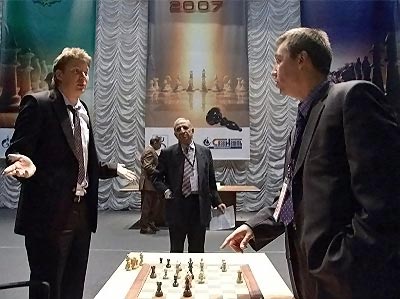
From ChessBase.com: American GM Gata Kamsky has won the FIDE World Cup.
Normally, the winner of the FIDE World Cup would be crowned the FIDE World Champion, but ChessBase.com reports that last year FIDE changed the rules so that the winner of the World Cup would have to play the previous winner -- Bulgaria's Veselin Topalov -- to become FIDE's World Champion. The match may end becoming something of a spectacle if Gata brings his dad, Rustam, along. Rustam was well-known during Gata's early years. From ChessBase.com:
A number of readers have suggested that the Kamsky-Topalov match could become really exciting if the American reactivates his famously belligerent father Rustam, to counter the activities of Topalov's manager Silvio Danailov. "That would be a wonderfully thrilling matchup," wrote one wag, "with explosive off-the-board play. We look forward to daily blow-by-blow reports on your news page."
I remember seeing Rustam at the 1993 FIDE candidates in Biel/Bienne Switzerland during a weekend that I took off while I was at Oxford University. I still have a picture of Gata playing against a long-haired Vladimir Kramnik. Maybe I will scan it in and post it sometime. I don't remember Rustam causing any trouble at the tournament; but there was always the fear that he would. I had a lot of great memories of that tournament. Every morning I would have breakfast with many of the Grandmasters all sitting at the same table. During one breakfast, German GM Eric Lobron animatedly explained his preparation in his win over GM Judit Polgar. I also had dinner with Former many-time U.S. Champion Yasser Seirawan and French GM Joel Lautier and Lautier's father. But I digress.
In any case, it is exciting to have an American at the top of Chess World again. Maybe this will spur some interest chess in the United States unlike we have seen in quite a while.
If I get a chance to talk to Gata between now and the match with Topalov, I will try to post that, too.
 ?
?Don't Know What To Buy? Try Amazon.com Gift Certificates
Amazon.com has sent me an e-mail with a special announcement: I get a whopping 6% return if you buy a Gift Certificate through my site (this month only). So, if you are one of those people who have trouble thinking of what to buy for Christmas, Hanukkah, Kwanzaa or any other special occasion, would you consider a Amazon.com Gift Certificate?
Friday, December 14, 2007
Chess World Cup Update: Kamsky Wins Game 2
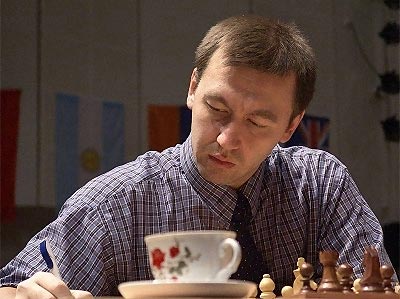
American Gata Kamsky won the second game of the finals match over Spain's Alexei Shirov for the FIDE World Cup Chess Championship. The first game was drawn. With two regular games yet to be played, Kamsky is in a very strong position as Shirov will have to win one of them to send it to a playoff. Kamsky started out with the black pieces and won his game today while playing the white pieces.

You can see the full report with an analysis of the game by Grandmaster Dorian Rogozenko at ChessBase.com.
Thursday, December 13, 2007
Eating the Seed Corn
After reading this short article today, Employees Raiding 401(k)s, CFOs Say (hat tip Calculated Risk), all I could do was shake my head. From the short article:
Considering that 401(k) accounts are almost always exempt in bankruptcy proceedings, my first thought is that people are eating their seed corn. There are rare situations where this is to the debtor's benefit. But something tells me most of these cases don't fall into those rare exceptions.
Lately, I have been thinking of the song Santa Monica by Everclear. In my own way I can identify with some of the lyrics of the song. The song is actually about a bad relationship breakup; but for me the selected lyrics sound somewhat like my new life by the Gulf Coast.
With my big black boots and an old suitcase
I do believe I'll find myself a new place
I don't want to be the bad guy
I don't want to do your sleepwalk dance anymore
I just want to see some palm trees
(I will) Go and try to shake away this disease
We can live beside the ocean
Leave the fire behind
Swim out past the breakers
Watch the world die
...
I'll walk right out into a brand new day
Insane and rising in my own weird way
I don't want to be the bad guy
I don't want to do your sleepwalk dance anymore
I just want to feel some sunshine
I just want to find some place to be alone
We can live beside the ocean
Leave the fire behind
Swim out past the breakers
Watch the world die
The survey finds that nearly 20 percent of companies have seen increased hardship withdrawals from 401(k) accounts, often to cover mortgage payments or to avoid personal bankruptcy.
"In the last four or five months we have seen an absolute onslaught of people trying to do hardship withdrawals and loans out of 401(k)s," Mark Anderson, CFO of Granite City Electric, told CFO magazine in October. "What has happened with housing and the economy has really blown up for people at the lower end of the spectrum."
Considering that 401(k) accounts are almost always exempt in bankruptcy proceedings, my first thought is that people are eating their seed corn. There are rare situations where this is to the debtor's benefit. But something tells me most of these cases don't fall into those rare exceptions.
Lately, I have been thinking of the song Santa Monica by Everclear. In my own way I can identify with some of the lyrics of the song. The song is actually about a bad relationship breakup; but for me the selected lyrics sound somewhat like my new life by the Gulf Coast.
With my big black boots and an old suitcase
I do believe I'll find myself a new place
I don't want to be the bad guy
I don't want to do your sleepwalk dance anymore
I just want to see some palm trees
(I will) Go and try to shake away this disease
We can live beside the ocean
Leave the fire behind
Swim out past the breakers
Watch the world die
...
I'll walk right out into a brand new day
Insane and rising in my own weird way
I don't want to be the bad guy
I don't want to do your sleepwalk dance anymore
I just want to feel some sunshine
I just want to find some place to be alone
We can live beside the ocean
Leave the fire behind
Swim out past the breakers
Watch the world die
Monday, December 10, 2007
An American Reaches the Finals of the FIDE World Cup Chess Championship

ChessBase.com reports that Gata Kamsky, who took a long sabbatical from competitive chess to obtain a law degree, has knocked out Norwegian wunderkind Magnus Carlsen to reach the finals of the FIDE World Chess Championship.
 I have little doubt that the talented Norwegian will become World Champion himself someday. Having just turned 17 years old, he still has plenty of time to hone his skills.
Gata will face either another child prodigy, Ukrainian Sergey Karjakin, or Spanish GM Alexei Shirov.
 Karjakin is already saying it is his generation's turn.
Sunday, December 09, 2007
Stuck In the Middle
Being a logical, rational person comes naturally for me. From my expertise as a chess player to my legal training, my mind is geared toward acceptance of scientific truths. I am probably unique in that I see no conflict between evolutionary theories of science and a faith that accepts the likelihood of a supernatural creation. Science can answer the question of how we got here; but it is up to philosophy and faith to attempt to explain the why.
Here is how Mark Heard explained his journey and conflict between faith and reason (from the liner notes to Stop the Dominoes):
Like Mark Heard, I have decided to forge my own path. And like Mark, I'm Stuck In the Middle.
Stuck In the Middle
It's a funny world we live in
It's funny every day
Half the world prays like the preacher
The other half don't even pray
So no one understands you
If you pray in your own way
Now I'm stuck here in the middle
Everything is in a jam
Stuck right in the middle
Doors on both sides seem to slam
No one seems to want me
Only God will take me like I am
Well my brothers criticize me
Say I'm just too strange to believe
And the others just avoid me
They say my faith is so naive
I'm too sacred for the sinners
And the saints wish I would leave
Now I'm stuck here in the middle
Everything is in a jam
Stuck right in the middle
Doors on both sides seem to slam
No one seems to want me
Only God will take me like I am
Written by Mark Heard
© 1981 Bug and Bear Music (ASCAP)
Here is how Mark Heard explained his journey and conflict between faith and reason (from the liner notes to Stop the Dominoes):
You referred earlier to your days as a skeptic. Is skepticism a sin, or does it seem to you a plague of sorts to those so minded?
Skepticism doesn't have to be viewed as a liability . Unfortunately, most of the time Christians see it that way. I have had hard times in the past because of that -- my questions were equated with sin by most of the believers around me, and that caused still more questions, like, ''well, shouldn't God's people be concerned enough about me to help me instead of crossing their arms and waiting for me to see things their way?" It bothered me for a long time. When a person has no rational basis for his faith, or feels that he has lost that rational basis, it is quite painful . It's hard to believe with your heart if there is conflicting information in your mind. To ignore the mind and brush off the questions is wrong, and is more an Eastern idea than a Christian one. So finally I figured, "well, if Christianity can't stand up to questioning, it's not the truth, and if it's not worth scrutiny, it's not worth believing." So my skepticism continued and led me to look deeply into the matters in question. Most of my answers came from quiet study. Skepticism was an asset to me in that it forced the roots of my faith to grow deeper.
Like Mark Heard, I have decided to forge my own path. And like Mark, I'm Stuck In the Middle.
Stuck In the Middle
It's a funny world we live in
It's funny every day
Half the world prays like the preacher
The other half don't even pray
So no one understands you
If you pray in your own way
Now I'm stuck here in the middle
Everything is in a jam
Stuck right in the middle
Doors on both sides seem to slam
No one seems to want me
Only God will take me like I am
Well my brothers criticize me
Say I'm just too strange to believe
And the others just avoid me
They say my faith is so naive
I'm too sacred for the sinners
And the saints wish I would leave
Now I'm stuck here in the middle
Everything is in a jam
Stuck right in the middle
Doors on both sides seem to slam
No one seems to want me
Only God will take me like I am
Written by Mark Heard
© 1981 Bug and Bear Music (ASCAP)
Friday, December 07, 2007
The Cost of War
This video will just make you shake your head in disgust or make you angry at the stupidity of unnecessary armed conflict.
Wednesday, December 05, 2007
Birthday Bash
Today at work, my co-workers threw me a "surprise" birthday party. (I kind of halfway expected it.)
Going to Answers.com today, I found out that I share a birthday with:
* Martin Van Buren (1782-1862): 8th President of the U.S.
* Walt Disney (1901-1966): of Mickey Mouse fame
* Frankie Muniz (22): actor, Malcolm in the Middle
And at ChessBase.com, I discovered I share the birthday with former FIDE World Chess Champion Rustam Kasimdzhanov.
***Update***
I forgot that I share a birthday with blogger Charles Smith of Of Two Minds. He also pointed out that the King of Thailand has the same birthday.
Going to Answers.com today, I found out that I share a birthday with:
* Martin Van Buren (1782-1862): 8th President of the U.S.
* Walt Disney (1901-1966): of Mickey Mouse fame
* Frankie Muniz (22): actor, Malcolm in the Middle
And at ChessBase.com, I discovered I share the birthday with former FIDE World Chess Champion Rustam Kasimdzhanov.
***Update***
I forgot that I share a birthday with blogger Charles Smith of Of Two Minds. He also pointed out that the King of Thailand has the same birthday.
Friday, November 30, 2007
Domino Theory
Back in February, I posted on of Mark Heard's songs One of the Dominoes. From the song:
Heaven help a seeker of truth
In an age of lies
Gonna make himself believe
That the truth is whatever he buys
Gonna buy what the world says to buy
In a monotone
Gonna cry when the whole world cries
And the truth is known
Heaven heaven help me
I'm one of the dominoes
Chain reaction coming
Blow by blow
Some economic blog commentators that I read have been mentioning a kind of economic "Domino Theory" of their own. A series of cascading financial failures through derivatives and debt instruments that will lead to potentially horrific economic losses. I'm not sure I'm smart enough to understand all this stuff. I'm trying to educate myself on macroeconomic theory and wade through the complexities. Hopefully, I've made the right decisions.
Heaven heaven help me. I'm one of the dominoes.
Heaven help a seeker of truth
In an age of lies
Gonna make himself believe
That the truth is whatever he buys
Gonna buy what the world says to buy
In a monotone
Gonna cry when the whole world cries
And the truth is known
Heaven heaven help me
I'm one of the dominoes
Chain reaction coming
Blow by blow
Some economic blog commentators that I read have been mentioning a kind of economic "Domino Theory" of their own. A series of cascading financial failures through derivatives and debt instruments that will lead to potentially horrific economic losses. I'm not sure I'm smart enough to understand all this stuff. I'm trying to educate myself on macroeconomic theory and wade through the complexities. Hopefully, I've made the right decisions.
Heaven heaven help me. I'm one of the dominoes.
Traditional Propaganda
Despair.com has come out with some new demotivators. Here are my favorite two:


You know, if I were smarter, I'd convince Dr. E. L. Kersten that I should get a percentage of the sales from the references from my blog like I do from Amazon.com. But I guess I'm just too big a sucker for that. From his latest e-mail to me (edited for grammar):


You know, if I were smarter, I'd convince Dr. E. L. Kersten that I should get a percentage of the sales from the references from my blog like I do from Amazon.com. But I guess I'm just too big a sucker for that. From his latest e-mail to me (edited for grammar):
Why shouldn't you get suckered again? You're great at it! Marketing people like myself love that part of you!
"Really? You love me? Even though I'm a big-time chump?"
Not "even though." Because.
Tuesday, November 20, 2007
Toy Soldiers
I originally entitled this post "Outrage of the Decade." I have since thought that the current title is more appropriate for the story.
Wounded Soldier: Military Wants Part Of Bonus Back:
If the Pentagon wants their money back, then give the soldiers their original limbs back. And their mental health back. And the time they lost with their families back.
I guess this is how the Bush Administration interprets "Supporting the Troops."
Wounded Soldier: Military Wants Part Of Bonus Back:
PITTSBURGH (KDKA) ―
The U.S. Military is demanding that thousands of wounded service personnel give back signing bonuses because they are unable to serve out their commitments.
To get people to sign up, the military gives enlistment bonuses up to $30,000 in some cases.
Now men and women who have lost arms, legs, eyesight, hearing and can no longer serve are being ordered to pay some of that money back.
One of them is Jordan Fox, a young soldier from the South Hills.
He finds solace in the hundreds of boxes he loads onto a truck in Carnegie. In each box is a care package that will be sent to a man or woman serving in Iraq. It was in his name Operation Pittsburgh Pride was started.
Fox was seriously injured when a roadside bomb blew up his vehicle. He was knocked unconscious. His back was injured and lost all vision in his right eye.
A few months later Fox was sent home. His injuries prohibited him from fulfilling three months of his commitment. A few days ago, he received a letter from the military demanding nearly $3,000 of his signing bonus back.
"I tried to do my best and serve my country. I was unfortunately hurt in the process. Now they're telling me they want their money back," he explained.
It's a slap for Fox's mother, Susan Wardezak, who met with President Bush in Pittsburgh last May. He thanked her for starting Operation Pittsburgh Pride which has sent approximately 4,000 care packages.
He then sent her a letter expressing his concern over her son's injuries, so she cannot understand the U.S. Government's apparent lack of concern over injuries to countless U.S. Soldiers and demands that they return their bonuses.
If the Pentagon wants their money back, then give the soldiers their original limbs back. And their mental health back. And the time they lost with their families back.
I guess this is how the Bush Administration interprets "Supporting the Troops."
Monday, November 19, 2007
How Many Tears
This song, from the Dry Bones Dance CD, sure sounds like an anti-war song.
How Many Tears
Gunmetal grey for golden rules
White hot steel for the comfort of fools
Molten wills in iron hands
Forge new sons for the Motherland
How many tears will fall down
How many tears must fall
How many tears will stain this ground
How many tears must fall
Hidden mounds in jungle dust
Youthful voices forever lie hushed
Poets and peasants know the truth
But what in the world can one man do
How many tears will fall down
How many tears must fall
How many tears will stain this ground
How many tears must fall
A mother’s eyes ache with her hatred
Her lips they are crippled with fear
She waits for the news that she don’t want to hear
How many tears
How many tears
How many tears must fall down
Ain’t no funerals
Ain’t no prayers
Ain’t no blood in the Government Square
Reign of terror
True and tried
Dries the eyes before they’ve cried
How many tears will fall down
How many tears must fall
How many tears will stain this ground
How many tears must fall
How many tears
How many tears will fall down
Written by Mark Heard © 1990 Ideola Music
The song can be heard at Rhapsody.com. It is song #8 at the link.
How Many Tears
Gunmetal grey for golden rules
White hot steel for the comfort of fools
Molten wills in iron hands
Forge new sons for the Motherland
How many tears will fall down
How many tears must fall
How many tears will stain this ground
How many tears must fall
Hidden mounds in jungle dust
Youthful voices forever lie hushed
Poets and peasants know the truth
But what in the world can one man do
How many tears will fall down
How many tears must fall
How many tears will stain this ground
How many tears must fall
A mother’s eyes ache with her hatred
Her lips they are crippled with fear
She waits for the news that she don’t want to hear
How many tears
How many tears
How many tears must fall down
Ain’t no funerals
Ain’t no prayers
Ain’t no blood in the Government Square
Reign of terror
True and tried
Dries the eyes before they’ve cried
How many tears will fall down
How many tears must fall
How many tears will stain this ground
How many tears must fall
How many tears
How many tears will fall down
Written by Mark Heard © 1990 Ideola Music
The song can be heard at Rhapsody.com. It is song #8 at the link.
New "Elephant" Oil Field Discovered in Brazil
From Business Week:
The oil industry is known for its "boom and bust" cycles. There is little doubt that the high oil prices are fueling the current boom. Although the article touts that this kills the idea of "peak oil," in reality it doesn't completely disprove the theory. The real idea of peak oil -- as I understand it -- is that oil will become increasingly expensive to extract.
Furthermore, the increasing use of hydrocarbons produce other environmental challenges due to the pollutants its use creates. These costs are externalities and cannot easily be quantified.
The high oil prices will also spur investment and study into alternative sources of energy. This will also reduce demand for oil as these alternative energy sources come into use. So far, the biggest impediment to alternative energy uses has been the NIMBY problem and (up to now) relatively large start-up expense. The latter issue is quickly resolving itself; what remains is to convince the public that some scenic views may have to be sacrificed, and (in the case of nuclear energy, if needed) that disposal of nuclear waste will have to be effected.
At some point, we will need to consider public financing of infrastructure to support the alternative energy sectors. I would find an analogy in the creation of railroads and highways. The real problem is how to avoid the problems of the past, namely: private profits underwritten from the socialization of costs.
Petrobras announced Nov. 8 it has found between 5 billion and 8 billion barrels of light oil and gas at the Tupi field, 155 miles offshore southern Brazil in an area it shares with Britain's BG Group and Portugal's Galp Energy. Tupi is the world's biggest oil find since a 12 billion-barrel Kazakh field was discovered in 2000, and the largest ever in deep waters. Perhaps more important, Petrobras believes Tupi may be Brazil's first of several new "elephants," an industry term for outsize fields of more than 1 billion barrels.
Initially, Tupi will produce about 100,000 barrels a day but may ramp up to as much as 1 million before 2020—more than the biggest U.S. field in Alaska's Prudhoe Bay, says Hugo Repsold, Petrobras' exploration and production strategy manager. "It's monstrous," says Matthew Shaw, a Latin America energy analyst at consultant Wood Mackenzie in London.
The oil industry is known for its "boom and bust" cycles. There is little doubt that the high oil prices are fueling the current boom. Although the article touts that this kills the idea of "peak oil," in reality it doesn't completely disprove the theory. The real idea of peak oil -- as I understand it -- is that oil will become increasingly expensive to extract.
Furthermore, the increasing use of hydrocarbons produce other environmental challenges due to the pollutants its use creates. These costs are externalities and cannot easily be quantified.
The high oil prices will also spur investment and study into alternative sources of energy. This will also reduce demand for oil as these alternative energy sources come into use. So far, the biggest impediment to alternative energy uses has been the NIMBY problem and (up to now) relatively large start-up expense. The latter issue is quickly resolving itself; what remains is to convince the public that some scenic views may have to be sacrificed, and (in the case of nuclear energy, if needed) that disposal of nuclear waste will have to be effected.
At some point, we will need to consider public financing of infrastructure to support the alternative energy sectors. I would find an analogy in the creation of railroads and highways. The real problem is how to avoid the problems of the past, namely: private profits underwritten from the socialization of costs.
Tuesday, November 13, 2007
Hydrogen Technology Now More Feasible
From Yahoo News: New technique creates cheap, abundant hydrogen: report:
CHICAGO (AFP) - US researchers have developed a method of producing hydrogen gas from biodegradable organic material, potentially providing an abundant source of this clean-burning fuel, according to a study released Monday.
The technology offers a way to cheaply and efficiently generate hydrogen gas from readily available and renewable biomass such as cellulose or glucose, and could be used for powering vehicles, making fertilizer and treating drinking water.
Numerous public transportation systems are moving toward hydrogen-powered engines as an alternative to gasoline, but most hydrogen today is generated from nonrenewable fossil fuels such as natural gas.
The method used by engineers at Pennsylvania State University however combines electron-generating bacteria and a small electrical charge in a microbial fuel cell to produce hydrogen gas.
...
In the past, the process, which is known as electrohydrogenesis, has had poor efficiency rates and low hydrogen yields.
But the researchers at Pennsylvania State University were able to get around these problems by chemically modifying elements of the reactor.
In laboratory experiments, their reactor generated hydrogen gas at nearly 99 percent of the theoretical maximum yield using aetic acid, a common dead-end product of glucose fermentation.
"This process produces 288 percent more energy in hydrogen than the electrical energy that is added in the process," said Bruce Logan, a professor of environmental engineering at Penn State.
...
One of the immediate applications for this technology is to supply the hydrogen that is used in fuel cell cars to generate the electricity that drives the motor, but it could also can be used to convert wood chips into hydrogen to be used as fertilizer.
The study appears in the Proceedings of the National Academy of Sciences.
Warren Buffett: Raise My Heir's Taxes
From CNN Money: Buffett: Tax my kin, please:
For more see my previous post: Estate Tax Reasoning.
"Without the estate tax, you in effect will have an aristocracy of wealth, which means you pass down the ability to command the resources of the nation based on heredity rather than merit," Buffett told the New York Times in 2001. "[Repeal would be like] choosing the 2020 Olympic team by picking the eldest sons of the gold-medal winners in the 2000 Olympics."
Buffett also joined a campaign in 2001 to preserve the estate tax alongside 119 other wealthy Americans, including George Soros and Bill Gates' father, William H. Gates, Sr..
...
Typically, fewer than 2 percent of deaths result in estates sizeable enough to be subject to the estate tax. In 2006, for example, less than 1 percent resulted in taxable estates.
For more see my previous post: Estate Tax Reasoning.
Tuesday, November 06, 2007
Mortgage Servicers Gouge Debtors
A report in today's New York Times, Dubious Fees Hit Borrowers in Foreclosures, shows how mortgage servicers can profit from the foreclosure process to the detriment of not only the borrower, but the economy as a whole.
Here are some of the examples from the story:
And to think that this is probably just the tip of the iceberg. Examples like these show why regulation of the mortgage industry is sorely needed.
Tanta, at Calculated Risk, has her own take on the article -- including her questioning of some of the assertions made in the article.
Because there is little oversight of foreclosure practices and the fees that are charged, bankruptcy specialists fear that some consumers may be losing their homes unnecessarily or that mortgage servicers, who collect loan payments, are profiting from foreclosures.
Bankruptcy specialists say lenders and loan servicers often do not comply with even the most basic legal requirements, like correctly computing the amount a borrower owes on a foreclosed loan or providing proof of holding the mortgage note in question.
Here are some of the examples from the story:
In one example, [Katherine M. Porter, associate professor of law at the University of Iowa] found that a lender had filed a claim stating that the borrower owed more than $1 million. But after the loan history was scrutinized, the balance turned out to be $60,000. And a judge in Louisiana is considering an award for sanctions against Wells Fargo in a case in which the bank assessed improper fees and charges that added more than $24,000 to a borrower’s loan.
...
On Oct. 9, the Chapter 13 trustee in Pittsburgh asked the court to sanction Countrywide, the nation’s largest loan servicer, saying that the company had lost or destroyed more than $500,000 in checks paid by homeowners in foreclosure from December 2005 to April 2007.
The trustee, Ronda J. Winnecour, said in court filings that she was concerned that even as Countrywide misplaced or destroyed the checks, it levied charges on the borrowers, including late fees and legal costs.
...
Loan servicing is extremely lucrative. Servicers, which collect payments from borrowers and pass them on to investors who own the loans, generally receive a percentage of income from a loan, often 0.25 percent on a prime mortgage and 0.50 percent on a subprime loan. Servicers typically generate profit margins of about 20 percent.
Now that big lenders are originating fewer mortgages, servicing revenues make up a greater percentage of earnings. Because servicers typically keep late fees and certain other charges assessed on delinquent or defaulted loans, “a borrower’s default can present a servicer with an opportunity for additional profit,” Ms. Porter said.
The amounts can be significant. Late fees accounted for 11.5 percent of servicing revenues in 2006 at Ocwen Financial, a big servicing company. At Countrywide, $285 million came from late fees last year, up 20 percent from 2005. Late fees accounted for 7.5 percent of Countrywide’s servicing revenue last year.
But these are not the only charges borrowers face. Others include $145 in something called “demand fees,” $137 in overnight delivery fees, fax fees of $50 and payoff statement charges of $60. Property inspection fees can be levied every month or so, and fees can be imposed every two months to cover assessments of a home’s worth.
...
Jeffrey M. Norton, a lawyer who represents the Trevinos, said that although MERS pays a flat rate of $400 or $500 to its lawyers during a foreclosure, the legal fees that it demands from borrowers are three or four times that.
...
Based on the study, mortgage creditors in the 1,733 cases put in claims for almost $6 million more than the loan debts listed by borrowers in the bankruptcy filings. The discrepancies are too big, Ms. Porter said, to be simple record-keeping errors.
Michael L. Jones, a homeowner going through a Chapter 13 bankruptcy in Louisiana, experienced such a discrepancy with Wells Fargo Home Mortgage. After being told that he owed $231,463.97 on his mortgage, he disputed the amount and ultimately sued Wells Fargo.
In April, Elizabeth W. Magner, a federal bankruptcy judge in Louisiana, ruled that Wells Fargo overcharged Mr. Jones by $24,450.65, or 12 percent more than what the court said he actually owed. The court attributed some of that to arithmetic errors but found that Wells Fargo had improperly added charges, including $6,741.67 in commissions to the sheriff’s office that were not owed, almost $13,000 in additional interest and fees for 16 unnecessary inspections of the borrowers’ property in the 29 months the case was pending.
“Incredibly, Wells Fargo also argues that it was debtor’s burden to verify that its accounting was correct,” the judge wrote, “even though Wells Fargo failed to disclose the details of that accounting until it was sued.”
And to think that this is probably just the tip of the iceberg. Examples like these show why regulation of the mortgage industry is sorely needed.
Tanta, at Calculated Risk, has her own take on the article -- including her questioning of some of the assertions made in the article.
Subscribe to:
Posts (Atom)