Monday, November 19, 2007

New "Elephant" Oil Field Discovered in Brazil

From Business Week:

Petrobras announced Nov. 8 it has found between 5 billion and 8 billion barrels of light oil and gas at the Tupi field, 155 miles offshore southern Brazil in an area it shares with Britain's BG Group and Portugal's Galp Energy. Tupi is the world's biggest oil find since a 12 billion-barrel Kazakh field was discovered in 2000, and the largest ever in deep waters. Perhaps more important, Petrobras believes Tupi may be Brazil's first of several new "elephants," an industry term for outsize fields of more than 1 billion barrels.

Initially, Tupi will produce about 100,000 barrels a day but may ramp up to as much as 1 million before 2020—more than the biggest U.S. field in Alaska's Prudhoe Bay, says Hugo Repsold, Petrobras' exploration and production strategy manager. "It's monstrous," says Matthew Shaw, a Latin America energy analyst at consultant Wood Mackenzie in London.


The oil industry is known for its "boom and bust" cycles. There is little doubt that the high oil prices are fueling the current boom. Although the article touts that this kills the idea of "peak oil," in reality it doesn't completely disprove the theory. The real idea of peak oil -- as I understand it -- is that oil will become increasingly expensive to extract.

Furthermore, the increasing use of hydrocarbons produce other environmental challenges due to the pollutants its use creates. These costs are externalities and cannot easily be quantified.

The high oil prices will also spur investment and study into alternative sources of energy. This will also reduce demand for oil as these alternative energy sources come into use. So far, the biggest impediment to alternative energy uses has been the NIMBY problem and (up to now) relatively large start-up expense. The latter issue is quickly resolving itself; what remains is to convince the public that some scenic views may have to be sacrificed, and (in the case of nuclear energy, if needed) that disposal of nuclear waste will have to be effected.

At some point, we will need to consider public financing of infrastructure to support the alternative energy sectors. I would find an analogy in the creation of railroads and highways. The real problem is how to avoid the problems of the past, namely: private profits underwritten from the socialization of costs.

Thursday, October 04, 2007

A Response to Alex Taylor III

Today, Alex Taylor III wrote an article posted at CNN Money wherein he criticized Thomas Friedman of the New York Times in his article Debunking auto industry myths. That all fine and good; but in the process he made (I feel) an unfair statement:

It has been argued here before that if the government wants to be serious about improving fuel economy, all it has to do is boost the tax on gasoline. The revenue generated could be rebated to lower-income drivers who are truly disadvantaged or invested in mass transit. The auto companies aren't going to argue for such a tax because it would give them a black eye with consumers. And the government won't do it either, because of its anti-tax bias.

But Friedman, using his column as a bully pulpit, could argue for such a tax with impunity. And it would be a whole lot more effective than perpetuating the old myth about the ignorant luddites in Detroit who are withholding the small, fuel-sipping cars that Americans really want to buy.

But he has argued for a tax on gasoline. Here is a quote from his column back in February:


But at the same time, we have to impose a tax that creates a floor price of $3.50 a gallon for gasoline — forever. This is also about leverage. It says to all the parties: we are going to conserve enough gasoline and spur enough clean alternatives to fossil fuels that no matter what you all do in the Middle East, we will not depend on you for energy.


Another thing I take issue with is his statement that U.S. automakers and Americans don't need to change their habits:

That's wrong...and wrong. Forcing people to buy more efficient cars by ordering car companies to make them is like forcing people to lose weight by banning food companies from selling Big Macs and pizzas. The reason Americans consume so much gasoline is that they like their big pickup trucks, SUVs, and V-8 engines. The reason the automakers make them is because people want to buy them.


He also tries to defend them by saying:

American manufacturers DO build fuel-efficient cars but Americans don't buy them.
Ford (Charts, Fortune 500) is currently offering cut-rate financing on the 2008 Escape Hybrid, while GM (Charts, Fortune 500) is subsidizing the smallest car in its lineup, the Chevy Aveo. And GM can brag all it wants about having more models - 30 of them - than any other manufacturer that get more than 30 miles per gallon on the highway, but it gets precious little credit for it in the marketplace.

The reason people (like me) don't buy them is because the quality is not as good as a Honda or Toyota -- even if it is cheaper. Furthermore, the Aveo's fuel economy is not as good as the Honda Civic or Fit or Toyota Echo or Yaris. (I know, I checked.)

Don't believe me? Here is the fuel economy for the Chevy Aveo:

City 26
Highway 35

And the Honda Civic:

City 30
Highway 38

You need only look at Consumer Reports or a similar opinion poll by consumers on what kind of car they want to buy to know that GM's economy cars have a ways to go in terms of quality. And as for the Escape Hybrid? It's hybrid engine is designed not to increase its gas mileage but instead to increase its power. That misses the point of hybrid technology.

Tuesday, August 14, 2007

Crazy From the Heat

I have not had any internet access at home, so I am blogging from my workplace.

I went down to the Gulf of Mexico and swam for 4 hours. The beach is only 30 minutes away, I discovered. When I came back, the air conditioning in my RV had failed. The ambient temperature has been 99 degrees Fahrenheit during the day, with the heat index at 110. So I had to spend the weekend in the heat. I think I might have lost some water weight from all the sweating. Don't worry, I'll gain it all back; I always do.

My job seems to be starting out well. Business activity is booming here along the coast. Besides the project we are working on, there are many oil refineries being built and there are several road construction crews out doing work upgrading the highways here.

If you are looking for work, you might want to look into getting a job with the oil industry. Everything it touches seems to turn to gold here.

Now if I could just get my internet up and running at home.

Friday, August 03, 2007

I Have Arrived

I actually arrived at 12:15am on Wednesday, but I didn't get internet access until tonight.

So far, I am quite pleased with my job. I am working on a project that will use carbon dioxide that would normally be a waste product from petroleum exploration (and is believed to contribute to global warming) to help extract more oil from the ground. See this page for more information about it. It is being advertised as a kind of "green" solution to oil exploration.

We are extremely busy with our project. Beaumont, Texas is a nice town. It's small enough that you don't have traffic jams at 5:00, but it's large enough that you have access to major shopping centers that you would expect in a large town.

If you need to see major sporting events or shows, Houston is only a little more than an hour away.

I am slowly settling in. After the initial shock of moving, I am quickly discovering that things are pretty good here. The weather is a little hot and muggy, but it isn't anything a little air conditioning can't fix. Besides, the ocean is not too far away, either. That's a premium when you are from a landlocked state.

Another difference in the weather is that the biggest threat is hurricanes rather than tornadoes. I was told with hurricanes you get days of warning rather than minutes.

The people I have met have been friendly for the most part; and I am already starting to think that some of my observations in Oklahoma may have been somewhat myopic. On the other hand, I think I may be living in a kind of oasis given what happened on the stock market today (and reading Charles Smith's predictions today at Of Two Minds).

I don't know how long this will last, but I intend to enjoy it while I can.

Saturday, July 28, 2007

A New Beginning

As of Wednesday, I am leaving the private practice of law. I have taken a job with a private company and because of the all of the work involved in the move, will be blogging lightly until I get settled in to my new position late in the week. I have a lot of work to do to prepare for the transition to my new life.

This is a time of sweet sorrow for me. No more Seven Years of Bad Luck. My fortunes appear to have changed. For the first time in I don't remember how long, I feel that I finally have some hope for the future. The oil industry is booming, and I am going to try to ride the wave for as long as I can.

Now it's the story of the Seven Fat Cows and the Seven Skinny Cows. I think we may be entering into a new time of the Seven Fat Cows. But we shouldn't become complacent. We must prepare for the Seven Skinny Cows. Oil is a cyclical market, and it is notorious for being a "feast or famine" and "boom and bust" market. And I am not even entirely convinced that it is not being manipulated right now. In any case, you have to strike while the iron is hot, and it sure looks hot to me.

Wednesday, June 06, 2007

New Toyota Prius To Get 125 MPG

Click on the title above to see the full article.

Wednesday, May 16, 2007

Is Saudi Arabia Running Out of Oil?

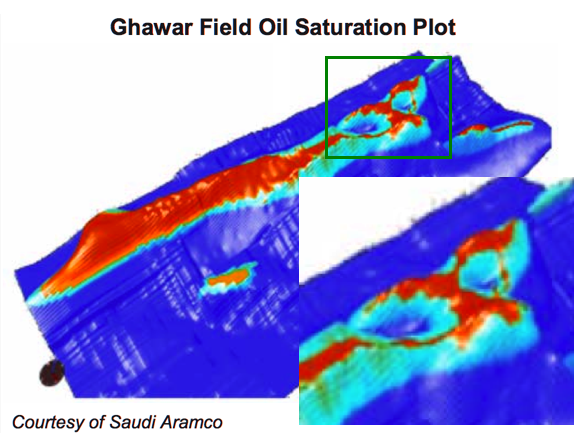
In a report over at The Oil Drum, blogger Stuart Staniford argues that the Ghawar oil fields are starting to get depleted and that this accounts for the recent rise in oil prices. The post comes with a lot of maps, charts and technical analysis. I am reproducing some of them here with some of his analysis.


Visualization of oil saturation in Ghawar, with focus region on 'Ain Dar and Shedgum regions at northern end. This is the "Linux Supercluster" picture (finder's credit Bob Shaw), showing a simulation visualization of the state of Ghawar at some year, probably but not certainly 2004. I have color reversed the original picture so that in this version, the red areas are interpreted to represent dry oil in the reservoir. The dark blue areas are water below the oil. The pale blue areas are interpreted to be swept, with most oil that can be removed already gone. Source: Figure 3 of Linux Clusters Driving Step Changes in Interpretation Simulation (pdf).

Mr. Staniford then asks:

Here the question is: is this an accurate picture of the state of recent depletion of Ghawar? (Ghawar is the world's largest oil field, and source of over half of the oil produced by Saudi Arabia).

And if so, then the second question arises: does that depletion have anything to do with this picture?


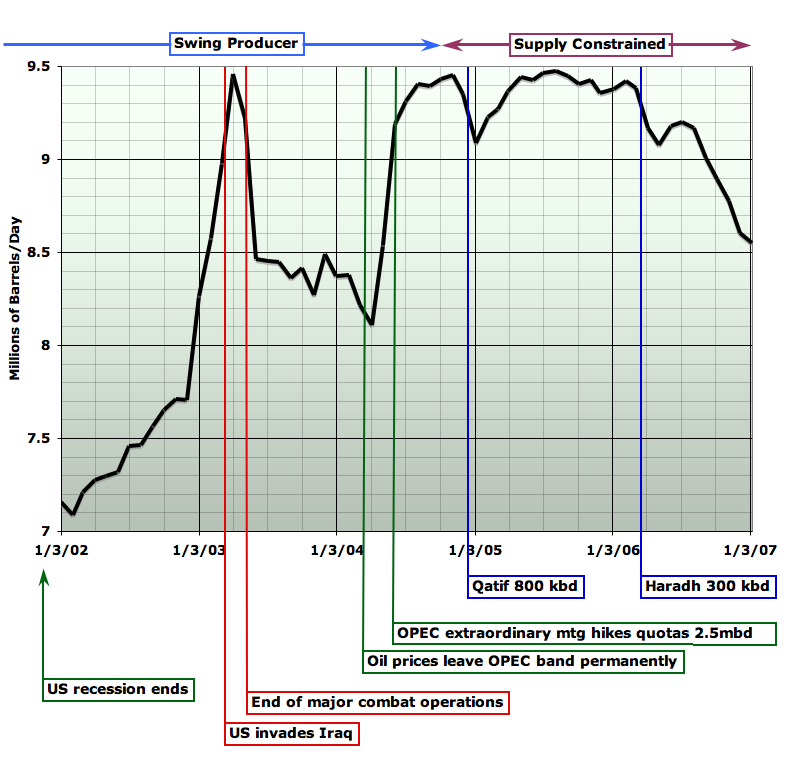
Saudi Arabian oil production, Jan 2002-Jan 2007, average of four different sources. Annotations show important events causally influencing production, including all documented megaprojects for new supply in the the time period. Graph is not zero-scaled to better show changes. Click to enlarge. Source: US EIA International Petroleum Monthly Table 1.1, IEA Oil Market Report Table 3, Joint Oil Data Initiative, OPEC Monthly Oil Market Report, Table 17 (or similar) on OPEC Supply.

In particular, Saudi oil production has been falling with increasing speeed since summer 2005, and overall, since mid 2004, about 2 million barrels of oil per day in production has gone missing (about 1mbpd in reduction in total production, and about another 1mbpd in that two major new projects, Qatif and Haradh III, failed to increase overall production). That's 2.5% of world production and, if that production hadn't gone missing, gasoline in the US likely would still be somewhere in the vicinity of $2/gallon instead of well over $3.

I will analyze six or seven separate lines of technical evidence, and argue they all point to a consistent picture, which says that the answer to both questions is "Yes". Yes, the northern half of Ghawar is quite depleted. And yes, this probably explains at least part of recent production declines. Furthermore, it is likely that more declines in Saudi production are on the way.


I don't know if this is disinformation just meant to create panic (and therefore drive up the price of oil), or if the shortage due to this one region is just temporary. I can just tell you that the general feeling is that cheap oil is starting to run out. In any case, I think that the link at the top is worth a look.

Before I go on, I think I should give a disclaimer (which I am borrowing, for the most part, from Mike Shedlock's site):

The content on this site is provided as general information only and should not be taken as investment advice. All site content, including advertisements, shall not be construed as a recommendation to buy or sell any security or financial instrument, or to participate in any particular trading or investment strategy (or an endorsement or recommendation of any product on any ad). The ideas expressed on this site are solely the opinions of the author(s) who may or may not have a position in any company or advertiser referenced above. Any action that you take as a result of information, analysis, or advertisement on this site is ultimately your responsibility. Consult your investment adviser before making any investment decisions.

If Saudi Arabia is truly starting to run out of oil, then we here in America need to get cracking developing technology to make our use of oil more efficient and develop alternative forms of energy. Most of our electricity comes from burning coal; and while we have a 250-year supply of it, it burns very dirty. Different areas of the country are more suitable to other, cleaner, forms of energy production: solar, wind and hydro power. Each of these are renewable and relatively clean forms of energy production. While current technology does not allow for these forms of energy production to be used widely, it would be wise for Americans to put our smartest minds to work creating more energy-efficient automobiles and buildings. Rather than looking toward converting food crops into more oil for our cars, we need to focus on making our cities more fuel efficient and develop more mass transit lines so that we can cut unnecessary oil usage.

It is my feeling that we, here in America, need to use our strength of innovation to solve our energy problems rather than looking for ways to produce more energy. Our real problem is that we are wasting too much energy that we have access to now. Reducing the demand on oil by conserving and increasing energy efficiency would be the smartest and most effective method of driving down our energy costs.

Friday, November 03, 2006

Man, talk about a fuel-efficient car!

This new Toyota Prius is a hydrogen-powered car that gets its hydrogen by using wind power to convert some other fuel source into hydrogen. It is not on the market yet, so don't go out and ask your Toyota dealer for it. But this is the sort of thing that can easily be implemented in Oklahoma, particularly western Oklahoma (where wind turbines actually make money).

Tuesday, September 19, 2006

October Surprise?

It is possible it is just the rumor mill brewing: there is a lot of talk on the leftist blogs/websites that the Administration is planning an "October Surprise." The rumor has it that it either a) involves invading Iran, or b) it involves blockading the Straight of Hormuz.

Something smells fishy about this report (read: leak). Fuel prices are coming down. On the other hand, as I have previously posted, there is a significant factor in the price of oil in fear and market uncertainty. I wouldn't be a bit surprised if someone who has something to gain from the belief that oil supplies will be disrupted wouldn't try to keep prices up by spreading such a rumor on leftist websites. Whatever it is, the markets don't seem to be acting like there is any risk of it. Not that markets act rationally.

Poster JPF311 at TalkingPointsMemo.com left a comment (you can see the discussion
here) that postulates two possible reasons for such a leak (I have edited his comment for clarification):

"1) Reassure the increasingly angry War on Terror hawks that the Bush Bunch hasn't gone squishy soft with all that fancy- shmancy Euro-diplomacy stuff and we are taking some sort of military action too; and

2) Bluff the Iranians into thinking that we are [prepared] to strike if they don't negotiate meaningfully."


I think there is another possible reason for the rumor: to make Liberal bloggers and opinion makers look "goofy" "conspiratorial" and "out of the mainstream."

I have no idea if there is anything to this rumor. I guess we will just have to wait and see.

Friday, September 15, 2006

Friedman on Brazil's response to high fuel costs

As a follow-up to yesterday's column here on oil manipulation, I saw today in the New York Times that Thomas Friedman (subscription required, which is only like $49.year -- roughly $4/month) has written about Brazil's response to the high price of oil. It turns out that sugar ethanol costs roughly half what ordinary gasoline costs. However, according to Friedman's article, ethanol makes roughly 30% less fuel economy than regular gasoline. So Brazilians simply do the math on the price of gasoline vs. the cost of ethanol.

The United States does not have enough cars that can run on ethanol to support widespread use of ethanol. Someone more technically savvy than me can explain it, but my understanding is that ethanol burns hotter, and is therefore harder on the engine's internal parts. If we were to produce ethanol here in the U.S., it would come from corn. However, corn-based ethanol is more expensive to produce according to a report at the Council on Hemispheric Affairs. I am not a farmer or scientist, but I think I read somewhere that corn is a pretty water-intensive crop to grow; and, unlike Brazil, the U.S. does not have that many rainforests. Lately, the midwest and plains have suffered drought conditions, which is not the best condition to expand corn crops.

Rather than try to come up with solutions that are dependent on climate forces, I suspect hybrid technology has more promise -- at least for the U.S. Besides, water is expected to become a more scarce and valuable resource in the future due to climate change. We do not need to waste it on alleviating our oil dependence.

Thursday, September 14, 2006

Oil: A Manipulated Market?

Today, over at the Of Two Minds blog http://www.oftwominds.com/blog.html, Charles Smith discusses the possibility that the oil market is manipulated.

You could certainly make a good argument that it is. The price of oil seemed to spike almost instantaneously over the last year. Just today, I heard the D.J. on K-LOVE radio http://www.klove.com/ mentioning how he read that the price of a gallon of fuel will fall to $1.15/gallon over the next few months. I doubt that that prediction will come true. The cost of extraction of oil is just too much at this point.

Other factors that factor in to the price of fuel at the pump include: the cost of transportation, refining capacity, marketing costs, taxes and the cost of the extraction of the crude itself. There is another factor that is not discussed on the mainstream sites like http://money.howstuffworks.com/gas-price.htm. That is the price of fear. A lot of the premium price of crude oil futures is the "fear factor." That is where price manipulation can take place. We have seen how the threat of terror has allowed politicians to manipulate Americans to constantly be in fear. In a lot of ways, the threat of war is used to manipulate the price of oil.

I do think that there is such a thing as "peak oil." The theory of peak oil states that at some point, the availability of cheap oil will pass because the extraction costs will rise due to the difficulty of getting the oil that is left in the earth. Although there is estimated to be a 100-year supply in the sands of Canada, the extraction costs (not to mention the environmental destruction costs, which in some ways is an externality -- a cost that is not easily quantifiable) are only justifiable as oil rises over $40/barrel.

So, the best evidence suggests that although the price of oil has been dropping as of late, the long term prospects says that the price will have to rise due to demand from developing markets, rising populations that will need it to heat their homes, fuel their cars and farm implements and generate other forms of energy. Also, in the long term, it will be necessary to develop efficient alternative renewable forms of energy (wind, solar, hydro and possibly nuclear).